

Custom Sex Toys and Fantasies: An Interview with Sylvain of You&Me FrenchToys
YOU&ME FRENCHTOYS
“Listening well is just as important as product quality.”
From automotive engineering to tailor-made desire
1. From mechanics to a very personal idea
Some men prefer to write to him on WhatsApp rather than call. They want to talk about anal pleasure, but sometimes worry about what this curiosity might say about them. Sylvain receives these questions as part of his work as a maker. He answers by talking about sensations, comfort and, sometimes, his own sexuality.
Before those conversations came a first intimate replica, made for his girlfriend at the time before she left for Australia. Then came a crisis in his automotive business, and the idea of putting 3D printing to work creating other kinds of objects.
A trained automotive engineer, Sylvain continues to run his first business. With You&Me FrenchToys, he has opened up another creative field. In this profile, materials and molds sit alongside less technical questions. How do you listen to a desire without labeling it? Why doesn't custom-made always mean making something bigger? And how far should you go when someone confides something deeply personal in you?
1. You trained as an automotive engineer and still run your automotive business. What made you want to start making sex toys too, and what have you carried over from your first profession into the way you design them?
My first company focuses on engine tuning in the automotive sector. Increasing power and converting vehicles to E85 are our main services, offered by nearly sixty franchisees across the country.
In 2023, we went through a major crisis related to E85 and suffered significant financial losses. It gave me a chance to reassess things. Even with a business established for fifteen years, nothing is guaranteed. So I wanted to develop something else, completely independent of the automotive industry.
At the time, we were already doing a lot of 3D printing to make automotive parts. I was amazed by how far the technology had come, and an old idea came back to me. I realized I could develop a 3D-printed mold system to make affordable products in France.
This idea has a history that goes back long before the brand. To tell it, Sylvain takes us back to his twenties and recalls his girlfriend's words.
2. Long before your brand, you made a first intimate replica for your girlfriend at the time, who was leaving for Australia. Can you tell me about it? Looking back, what did that object mean to you, beyond the challenge of making it?
That goes back to when I was twenty. My girlfriend at the time was going to Australia to study. Before she left, she said to me, “Oh my, it's so far away, I'm going to miss your cock…” Sorry, I'm quoting her! I replied, “True, Australia is pretty far away, after all.” And she said, “Well, then you should make a replica of your cock.” I took her literally…
I didn't have the right technical resources, and back then none of the cloning kits you can find today existed. I did it the old-fashioned way, using alginate, a kind of plant-based gel used to take body impressions, then pouring plaster to make the “master”.
The final object was made of latex. Silicone was too complicated to work with at the time. I gave it to her. She was surprised but delighted, and took it with her. And she never came back, either, hahaha!
Today, we're preparing to expand into Australia, so this is especially meaningful for me! We're working on the legal side with local accountants and lawyers. I think everything will be in place by early 2027.
That first creation was made in response to a private request. When an idea becomes a business, you have to explain it to other people. Colleagues and friends don't all react with the same enthusiasm.
3. You say that some friends and colleagues found it hard to believe in this project. How did you experience their reaction to this new line of work related to sexuality, and what's changed since then?
It wasn't easy at first. When I presented the project to my colleagues, they thought, “That's it, the boss has completely lost the plot.”
Some people around me thought it was a brilliant idea, while others found it very surprising, to put it politely, and didn't believe in it at all. It's also true that this is a highly competitive sector. I persevered anyway, and today I think I've shown them that the gamble was far from absurd. Those who struggled to believe in it at first have changed their minds. It's surprising, but it works.
Even today, some people are astonished when I tell them I work in the automotive industry and in adult toys. But now that the business is working and has become more structured, it's much easier to help them understand that, in the end, it's a business like any other.
2. Quality goes beyond choosing a material
Success makes the project easier to explain. But it doesn't, by itself, answer another question raised by this line of work. These objects are made for the body. In his answers, Sylvain emphasizes the choice of materials just as much as the way the designs are conceived.
4. In your messages, you often come back to silicone quality and the safety of the people who will use your toys. What research and testing led you to choose your materials? Was there a discovery that particularly changed the way you make them?
When I launched the project, one of my main goals was to offer a product that was genuinely safe for the body. I wanted to go beyond the minimum requirements.
Silicone naturally became the material of choice. It's soft, flexible, very durable and chemically inert, making it perfectly suited to this kind of use. We work exclusively with manufacturers whose silicones are tested by independent laboratories, to ensure a consistent level of quality and safety.
It's worth clarifying what this requirement involves. So I asked him how it translates into practice beyond the choice of material—in composition, design and production oversight.
5. You mentioned the lack of mandatory standards in this sector. The international standard ISO 3533:2021 has been in place since 2021, but remains voluntary. What role does it play in your work? And beyond the word “safe,” what tests or documents can verify the safety of your finished toys, including their colorants and finishes, rather than just the silicone they start with?
After studying ISO 3533:2021, we incorporated its main criteria into our product designs from the outset. Our toys are deliberately made with a very simple composition: about 99% platinum-cure silicone and 1% pigments. The silicone we use, as well as our colorants, have ISO 10993 biocompatibility data, so every component that comes into contact with the body is selected using documented safety criteria.
The laboratory analyses I mentioned are available from my silicone suppliers. They cover the raw materials, not the finished toys. Since the combinations of silicones and colors are virtually endless, hundreds of combinations would have to be validated. In general, we mix raw materials that are each certified in their own right.
We've also addressed risks related to the design itself. For anal use, for example, all our models either have a base that's wide enough to reduce the risk of retention or a retrieval system, such as the chain found on some of our models.
Beyond the raw materials, we also ensure traceability for components and production batches, and incorporate risk analysis into the design of our models.
Since ISO 3533 is a voluntary standard, we mainly use it as a design and safety framework, rather than as a simple marketing claim.
3. Seeking a sensation, not a performance
Diameter, length, firmness. The criteria seem concrete. Yet Sylvain describes the start of the custom process as a conversation about a sensation that can be hard to put into words. You need to be able to talk about what you're looking for, but also what doesn't feel right.
6. You offer custom shapes, sizes and firmness levels. How do you turn a desire that's sometimes hard to describe into a toy suited to the sensations and comfort someone is looking for, without reducing pleasure to a question of size or performance?
Here you're talking about our ability to make 100% custom dildos. With a range of more than fifty different models, these requests are fairly rare, but they're always interesting because they mean having a more in-depth conversation with the customer.
We generally start by understanding what they're really looking for: the type of sensations, desired firmness, shape, diameter, usable length, as well as their experience and what already works for them—or, conversely, what they want to avoid.
The goal isn't simply to make something “bigger” or “longer”. A difference in curvature, the way the diameter increases, texture or flexibility can have a much greater impact on sensations than a simple change in size.
So we try to translate a desire that can be quite subjective into concrete technical criteria, then suggest something that makes sense in terms of comfort and use. Our experience with different silicones and the many geometries already in our range also helps us guide customers when their initial request might not produce the result they're imagining.
For us, custom-made is above all about creating a toy that genuinely suits a person and their sensations, not about chasing performance.
4. Pleasure doesn't need a label
There can be a long distance between a shape that might suit a desire and feeling able to express that desire. In his conversations with men interested in anal pleasure, Sylvain encounters questions that go beyond product specifications.
7. When men talk to you about anal pleasure, what kinds of questions or hesitations come up? Do some mention being afraid of judgment or of being labeled?
Yes, definitely. Many men are still very uncomfortable bringing up the subject directly and prefer to contact us by email or WhatsApp rather than call. Having that intermediary creates a kind of reassuring distance and lets them ask questions more freely.
There are still a lot of misconceptions about male anal pleasure, and some men are afraid it might call their image, masculinity or sexual orientation into question. Yet in these conversations, what we mostly see is curiosity and a desire to discover new sensations.
In those cases, I talk quite naturally about my own experience. I'm heterosexual, but I enjoy prostate pleasure, and my wife and I test our creations both on her and on me. That lets me answer without judgment, with concrete feedback about the sensations, comfort and how the products work in real use.
I think the most important thing is to take the drama out of the subject. Anal pleasure doesn't need to be associated with a label. It's simply one form of pleasure among many, and everyone should be able to explore it without having to justify themselves.
This time, the maker doesn't stay behind his product sheet. He talks about what he enjoys himself and the testing he does with his wife. But in the conversations he receives, that freedom to talk isn't always so easy to find within a couple.
8. In your conversations with customers, what strikes you about the way couples talk about their desires and purchases?
In couples, whether it's the woman or the man, there are often major differences between each partner's desires. It's common for some people to hide a purchase from their partner or not dare to talk about it and play together. That's a shame.
5. From unusual requests to imaginary worlds
The creations furthest from traditional designs sometimes have a very personal story behind them. The one he tells here sparked his creativity. But Sylvain also talks about the distress he says he heard and the follow-up from the customer who approached him.
9. What's the most unexpected custom request you've received? You told me about a horse-inspired toy, for example. Without sharing details that could identify the person, how did you take on that creative challenge?
A customer told me about urges she said she couldn't control, related to equine zoophilia. She wanted to stop acting on them and was looking for an outlet in the form of a really realistic toy, but one that was more anatomically suitable.
We developed an equine-inspired toy for her with the features she wanted, in terms of both shape and size. The request really moved me, because I could sense a kind of distress in her voice. I was delighted when she called me back to say she really liked the toy.
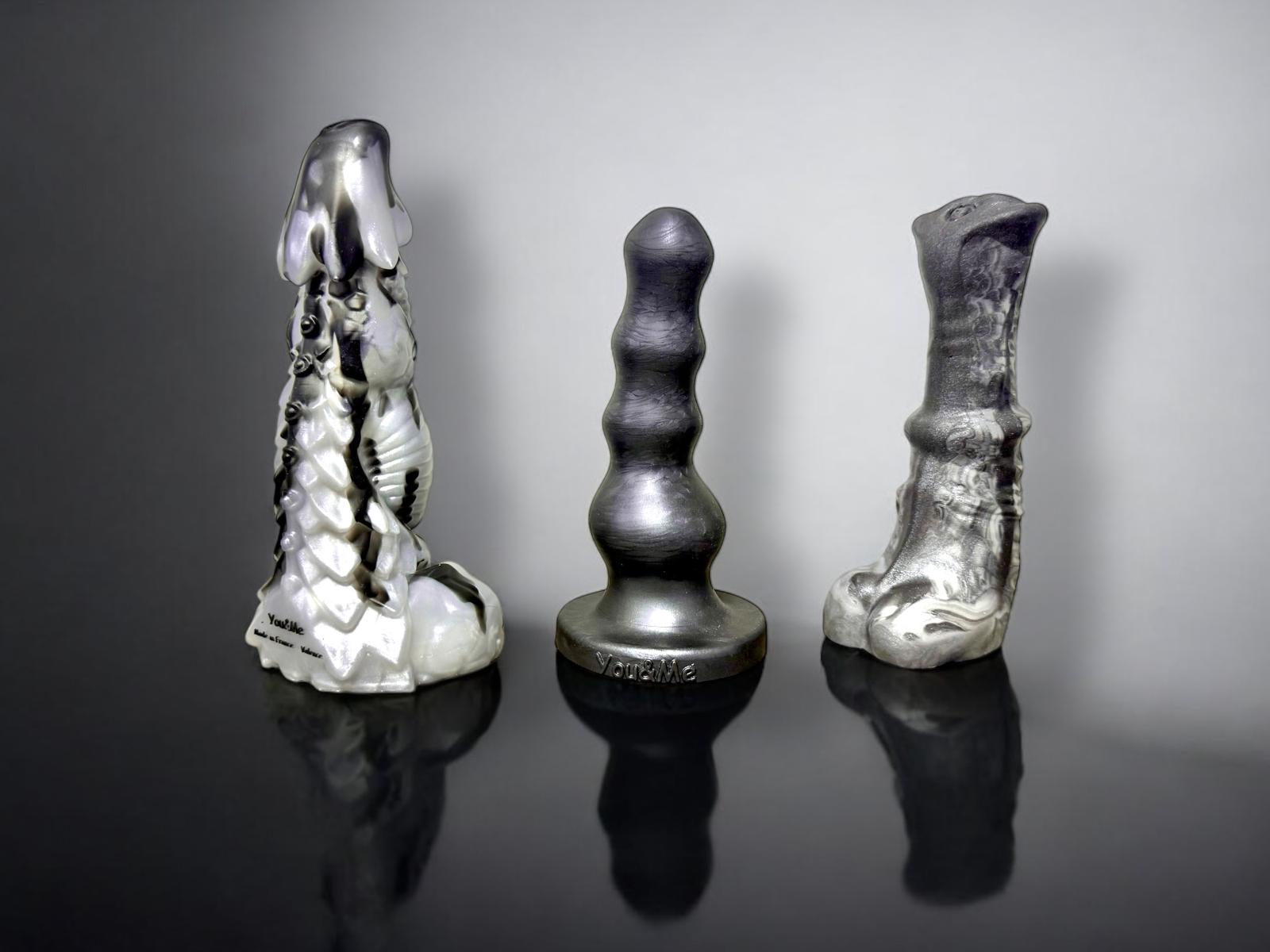
It was a very unusual request, but it also sparked our creativity. From there, we started developing more fantasy and animal-inspired designs, such as the Loup-Garou, Bamby and EquusLupus.
And in the end, these models have been very successful. There's a real audience for more original, more imaginative shapes, sometimes very far removed from traditional realism. I prefer to talk about unusual tastes or original fantasies rather than things that are “twisted.” As long as it's between consenting adults and within a safe setting, everyone is free to explore what they enjoy.
Today, our catalog has more fantasy models than realistic ones.
The story explains how part of the range came about, not why everyone who chooses it does so. When Sylvain talks about the fantasy creations, he also speaks about fantastical worlds, aesthetics and the pleasure of owning an object that doesn't look like anything real.
10. You also develop imaginary creations, far from realistic designs. From what your customers tell you, how much do their world and aesthetic matter to desire, beyond the sensations they're looking for?
For fantasy models, aesthetics matter enormously. Some customers aren't simply looking for a shape that produces a particular sensation. They also love the world that comes with it—the creature-like, fantastical, monstrous or completely unreal side of it. That's typical of our “Alien” or “Hentai” dildo. The toy almost becomes an object of fantasy in its own right.
Its color, textures, proportions or simply the fact that it doesn't look like anything real are just as much a part of the experience as its functional shape.
That's also what makes this range so interesting to create. We can free ourselves much more from anatomical constraints and work on shapes that would be impossible in a realistic model. Some customers almost buy as much for the object and its aesthetics as for how they use it.
6. Openness doesn't erase boundaries
Imaginary shapes open up creative possibilities. They don't remove the constraints of use. Sylvain doesn't see his role as simply carrying out every request and automatically agreeing with the customer. He also wants to be able to suggest something else.
11. You want to welcome desires without judgment. What might lead you to adapt a request or say no, and how do you explain that to the person?
I don't judge a desire because it's unusual. However, I may refuse or modify a request if I think it poses a risk in use, can't be made properly from a technical standpoint, or involves something I don't want to be associated with.
Sometimes a customer imagines a shape or size that seems interesting on paper but, once made in silicone, would actually be uncomfortable or difficult to use. In that case, I'd rather explain why and suggest an alternative than make exactly what they asked for, knowing the result could be poor.
The point of custom work isn't to say yes to everything. It's to understand the desire behind the request and find the best way to make it achievable, comfortable and safe.
“The point of custom work isn't to say yes to everything.”
He reserves the right to modify a request. But these conversations can affect him, too. His customers bring him ideas he wouldn't have come up with, and when he tests the creations, some of the sensations surprise him.
12. You spend a lot of time giving shape to other people's desires. Has a customer's idea ever sparked your own curiosity, beyond the manufacturing challenge?
Yes, of course. When you talk to so many people with different practices, desires and sensibilities, some ideas you would never have thought of yourself can spark your curiosity.
I've already developed a model based on a customer's request, then tested it as part of product development and discovered that a shape or sensation I wouldn't have sought out spontaneously was actually very interesting.
That's also what I love about this work. There's a constant exchange in both directions. Customers bring us ideas, we turn them into technical designs, and sometimes that opens up new possibilities for the whole range.
7. Staying in touch, keeping the choice open
Behind the expansion into stores and projects abroad, one question remains. If the brand grows, who will respond to the person who doesn't dare call? Sylvain considers this personal connection just as important as the manufacturing itself.
13. You told me about a small team, expansion into stores and international projects. As You&Me grows, what do you absolutely want to preserve in your relationship with the people who confide their desires in you?
I absolutely want to preserve direct contact. Today, when someone writes to us with a very specific or sometimes very personal question, they're really speaking with people who know the products, how they're made and how they're used.
I don't want You&Me to become a brand where customers are faced only with automated responses or a customer service team that recites a product sheet. In our field, people sometimes confide very intimate things in us, and listening well is just as important as product quality.
Even as the brand grows and expands internationally, I'd like to keep that closeness, be able to give honest advice, say when a product probably isn't suitable, guide someone toward another size or firmness, and remain accessible.
For me, this human connection is as much a part of You&Me's identity as making our products ourselves.
At the start of his story, he took a desire his girlfriend expressed literally. As he wraps up, he also reminds us of another possibility: you can talk about a desire without wanting to act on it. A conversation doesn't oblige you to turn every curiosity into an experience.
14. After everything this work has helped you discover, what would you say to someone who has a desire but doesn't yet dare to express it, even to their partner?
I'd tell them first: “Having a desire or curiosity doesn't obligate them in any way to act on it.” But being able to put it into words often helps you understand better what you're really looking for.
In our daily conversations with customers, we realize that many fantasies people think are extremely unusual are actually much more common than they imagine. In a couple, talking about them can also be much easier than you fear. What's important is being able to express a desire without imposing it on the other person, and leaving each person free to be curious, interested or not.
And if someone isn't ready to talk about it with their partner yet, they can take time to understand the desire for themselves, without shame and without feeling obliged to label themselves. As long as everything stays between consenting adults, with respect for everyone and in a safe setting, there's no reason to consider curiosity something to be ashamed of.
The story began with a replica made before a departure. It closes with the right to keep a curiosity to yourself. Along the way, Sylvain has talked about silicone, sensations, images and words that can sometimes be difficult to share. What he wants to preserve as the business grows is more than know-how. It's the possibility for the person who writes in to find someone who really responds.
Discover You&Me FrenchToys
To discover You&Me FrenchToys' creations and explore its world further, the brand's website, blog and X account are listed below.
You&Me FrenchToys website | The blog | You&Me on X
#SextoysSurMesure #fantasmes #sexualitepositive #MadeInFrance



Loading...